D Hote Menu: Meaning, Structure and À La Carte Differences
A D Hote Menu is a fixed-price meal of set courses. Learn its typical structure, how it differs from à la carte ordering, and how to read one.
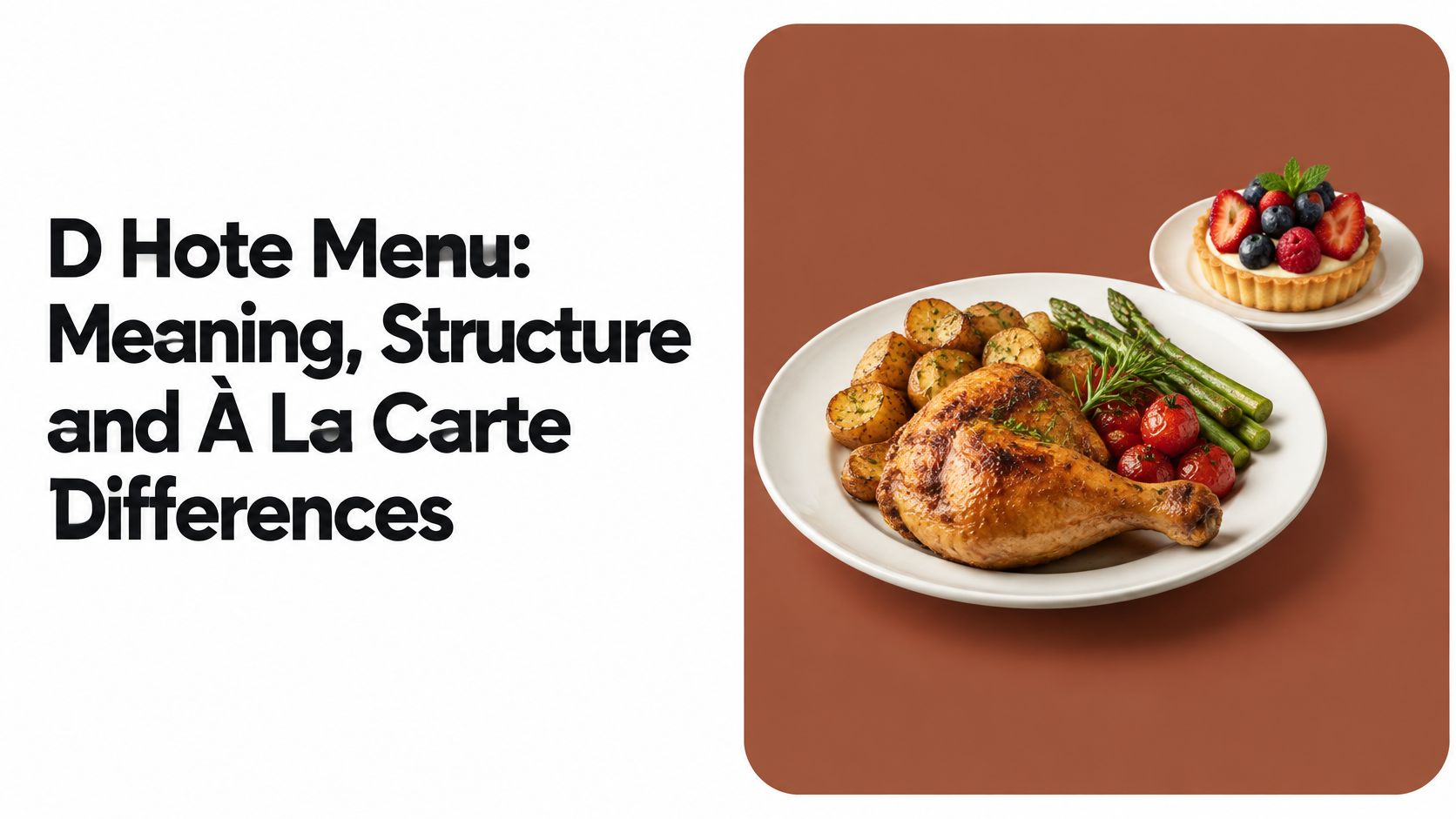
A d hote menu is a fixed-price meal of set courses, with a limited choice in each course, rather than dishes priced one at a time. But does a fixed price mean everyone must eat the same dishes?
Usually, the important distinction is between a fixed meal structure and a fixed dish selection. Diners may still choose their starter, main and dessert, but from shorter lists. The useful clues aren't the French words at the top. They're the course headings, the options beneath them and the explanation of what the price includes.
What a D Hote Menu Means
A d hote menu, usually written table d'hôte, offers a complete meal for a set price, with choices arranged by course. A diner selects from the options within that structure rather than building a meal from separately priced dishes.
The name explains its original idea. The culinary guide Menupresso's explanation of table d'hôte translates the French term as “the host's table” and describes both its shared-table meaning and its restaurant-menu use. The historical association is with inns where travellers shared a meal at an established time and price, rather than ordering freely from a long list.
Different names, similar arrangements
Prix fixe means “fixed price” in French. WebstaurantStore's prix fixe guide describes a multi-course meal sold for a fixed price, sometimes called table d'hôte, with either choices within courses or dishes selected beforehand.
Usage varies by region and restaurant. Prix fixe is often encountered in North American dining, while table d'hôte puts more emphasis on the complete meal. Neither label guarantees a particular number of courses or a particular amount of choice.
An everyday comparison is a combo meal with a sequence. The price covers the arrangement, while the diner makes selections inside each available slot. The difference is that a restaurant set menu normally organises those slots into courses served in order.
Practical rule: The headings and price explain the offer more reliably than the menu's name.
A menu labelled table d'hôte may offer several dishes under every course. Another may offer no alternatives at all. If a single price covers several course headings, and those headings list the available selections, the diner is looking at a set-menu structure.
Typical Course Structure at a Glance
Typical set menu formats
| Format | Courses included | Typical choices per course | Common setting |
|---|---|---|---|
| Two-course set | Main plus starter or dessert | 2 to 3 | Weekday lunch or early dinner |
| Three-course set | Starter, main and dessert | 2 to 3 | Standard dinner service |
| Four-course set | Starter, fish or soup, main and dessert | 2 to 3 | Special or celebration dinner |
| Tasting menu | Five or more small courses | Often none; chef selects | Special occasion |
These are illustrative patterns from general restaurant practice, not measured averages or rules that every venue follows. A restaurant's actual course headings and ordering conditions take priority.
The familiar three-course arrangement moves from starter to main to dessert. A starter list might contain soup of the day, goat cheese salad or pâté. Main choices could include roast chicken, pan-fried fish or vegetable risotto, followed by crème brûlée, sorbet or a cheese plate.
A two-course lunch shortens that sequence. A diner might choose soup followed by chicken, or chicken followed by sorbet. The menu needs to say whether both combinations are available, since some lunch offers include only a starter and main.
Longer meals and fewer decisions
A four-course arrangement adds a separate dish, such as soup or fish, between the opening course and the main. For example, salad might precede a small fish course, roast chicken and dessert.
A tasting menu is the edge case. It uses a longer sequence of small dishes, often chosen by the chef rather than selected individually by the diner. Its fixed price doesn't necessarily mean it offers the same freedom as a table d'hôte menu.
Limited options let cooks prepare ingredients around a defined service plan. Operators considering a shorter daytime offer can use these café menu ideas to think through suitable dishes without assuming every café needs a formal dinner structure.
Count the course slots first, then count the choices inside each slot.
Drinks, coffee, service charges and premium dish supplements may sit outside the advertised price. A steak upgrade, for instance, needs a clearly marked extra charge rather than an assumption that every main is included.
How a Set Menu Differs From À la Carte
A set menu trades some freedom for a predictable base bill and an organised meal sequence. À la carte gives diners more control over which dishes they order and how much food they commit to.
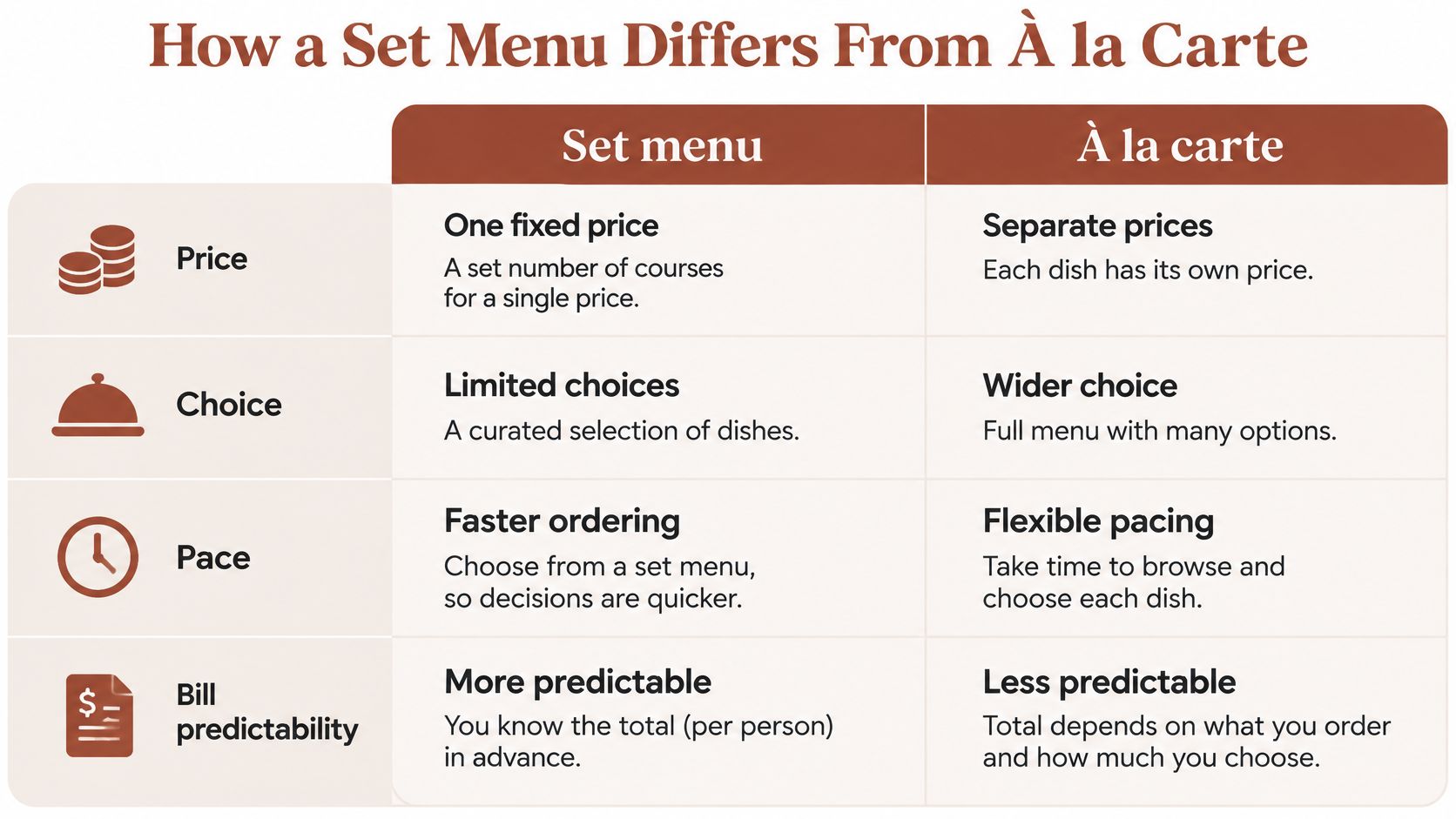
Set menu compared with à la carte ordering
| Criterion | Set menu (d hote menu) | À la carte |
|---|---|---|
| Pricing | One price for the listed courses | Each dish priced separately |
| Choice | Limited options in each course | Full menu of dishes |
| Bill predictability | Known base cost before ordering | Total depends on what is ordered |
| Pace | Courses follow a planned sequence | Guest orders course by course |
| Customisation | Few swaps; substitutions vary by kitchen | Easy to mix, skip or adjust |
| Kitchen planning | Prep planned around fixed options | Harder to forecast which dishes sell |
| Best for | Celebrations, groups, fixed budgets | Light meals, flexible diners, quick visits |
Fixed price doesn't automatically mean better value
A set menu can cost less than ordering equivalent courses separately, but the relevant comparison is what the diner would otherwise order. Someone planning a starter, main and dessert may find the package attractive. Someone wanting only soup could spend less by ordering à la carte.
Included dishes matter as much as the headline price. A set built around dishes a guest doesn't want isn't necessarily good value, even if buying all its components separately would cost more.
Pace also needs a careful reading. Fewer choices can make ordering quicker, but a set menu doesn't promise a short visit. A celebration dinner may deliberately unfold slowly, while a lunch set may be designed around a tighter service window.
À la carte diners can choose their course sequence, although many restaurants still take the whole order together. Greater choice also doesn't guarantee that a kitchen can safely accommodate every dietary change.
Matching the format to the occasion
For operators, a defined dish selection makes ingredient preparation easier to organise. An unrestricted menu leaves more possible combinations to anticipate, particularly when demand concentrates unexpectedly on a particular dish.
A set menu suits a group seeking a shared evening, a celebration with a planned progression or a meal with an agreed base budget. À la carte suits a lighter appetite, a brief stop or a diner who wants an unusual combination.
The deciding question is practical: Does the guest want the complete experience being offered, or only selected parts of it?
How to Order From a Set Menu
The safest approach is to resolve the conditions before choosing dishes. A short conversation at the start prevents confusion when the food arrives or the bill is presented.
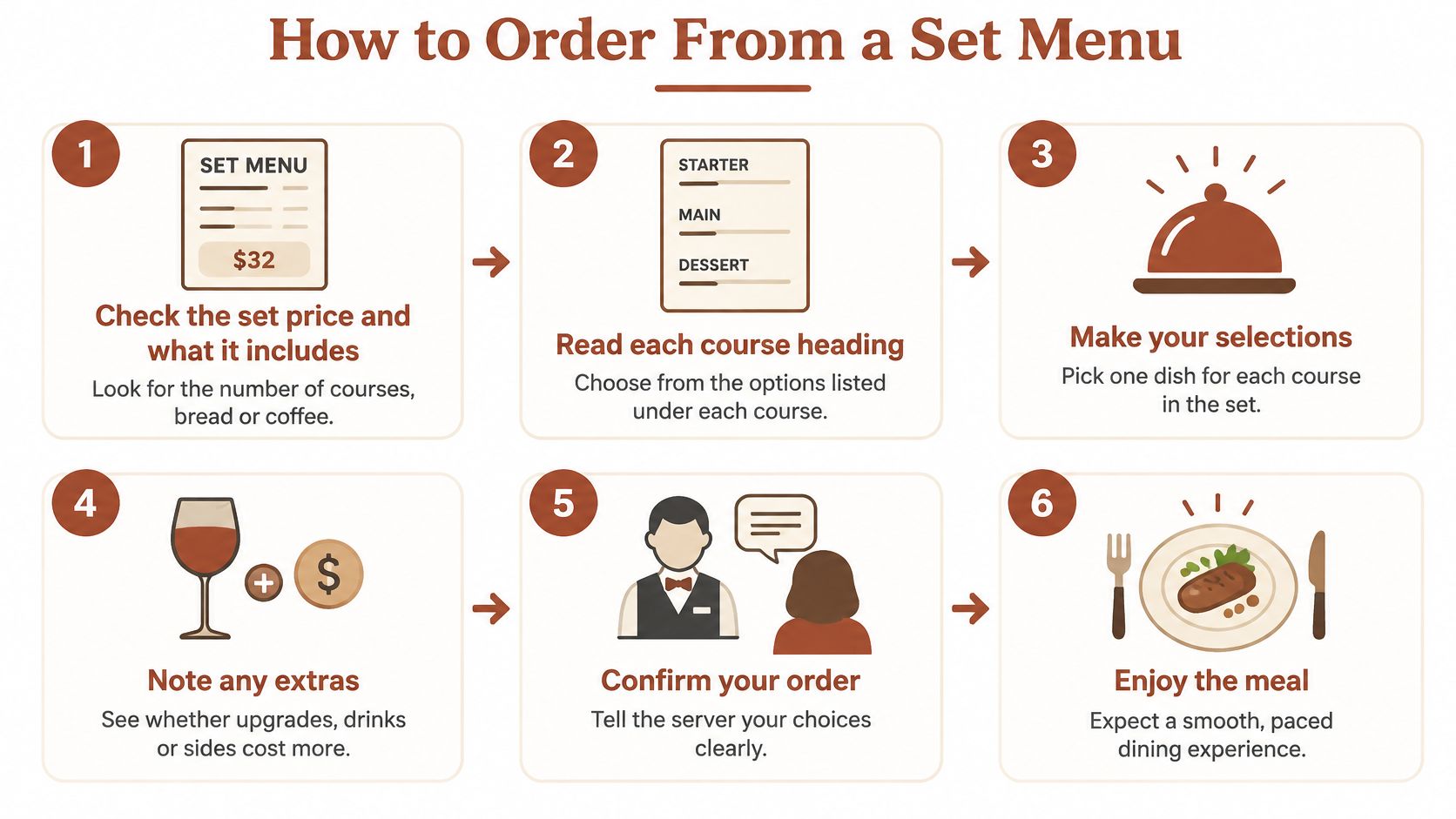
Check the set price and inclusions. The menu should identify the courses covered and whether bread or coffee is included. A heading alone shouldn't be treated as confirmation that every accompanying item is free.
Read every course heading before selecting. Each diner normally picks a dish from each included course. Reading the whole sequence helps avoid an unexpectedly heavy meal or repeated ingredients.
Raise allergies and dietary requirements before ordering. The kitchen needs to confirm whether a dish or substitution is suitable, rather than leaving the server to guess. Clear symbols help, but the Food Standards Agency's consumer study on allergen information also highlights demand for ingredient detail and accessible information.
Decide on supplements before confirming the order. An upgraded main, extra side or paired drink changes the total. The additional charge should be understood before the kitchen starts preparing the meal.
Confirm the whole-table rule. A common misunderstanding is that everyone must choose identical dishes, although choice-based sets generally allow individual selections. Separate rules may require the whole group to take the set rather than mix ordering formats.
Check the service window. Lunch, early-evening and event offers may apply only during stated periods. A guest arriving near the cutoff should confirm availability before settling on the offer.
Reading the final bill
The bill should show the set meal charge for each diner, followed by separately identified extras such as drinks, supplements and service. An unexplained duplicate set charge, or an included course that never arrived, deserves clarification before payment.
Before paying: Compare the bill with what was agreed, not just with the large price printed above the dishes.
Recognising Set Menus in Examples and Real Menus
The following are fictional examples with illustrative prices, not offers from operating venues. Their purpose is to show how the same broad idea appears in different hospitality settings.
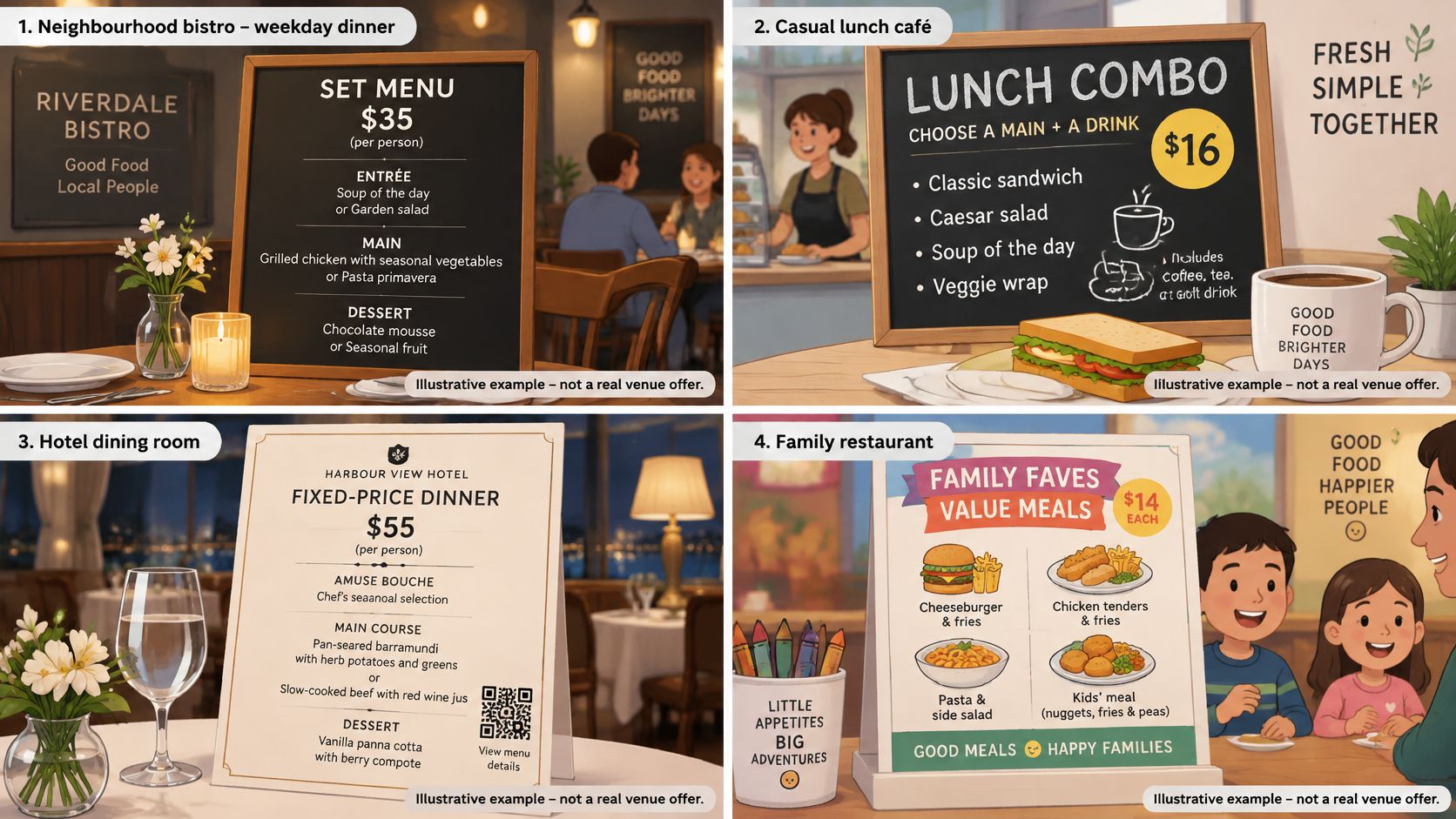
Everyday offers with different structures
Neighbourhood bistro dinner. An illustrative $35 three-course set offers leek soup or goat cheese salad, then braised beef or seabass, followed by chocolate tart or fruit sorbet. The diner chooses within each course, while the base price remains the same.
Hotel restaurant lunch. An illustrative $24 two-course lunch lists soup or a small sandwich first, followed by a salad or pasta main. Portion descriptions matter here: without them, a sandwich followed by pasta could look like a confusing list of interchangeable lunch dishes rather than a planned sequence.
Café brunch. An illustrative $18 brunch includes a small bowl or toast, a main and filter coffee. The operator should distinguish food courses from the included drink, rather than counting coffee as another food course.
Cocktail bar and pizzeria bundles. A snack-and-drink pairing is a fixed bundle, but it isn't necessarily a course-by-course meal. A pizza-and-dessert combo sits closer to a short set menu, particularly if dessert follows the pizza and each stage offers alternatives.
The useful distinction is whether the offer presents several courses with their own choices or groups products together. A drink plus a snack is a bundle; a meal arranged as successive courses is a set-menu format. Operators developing pairings can compare ways of organising drink menus for bars without describing every package as table d'hôte.
Visible signs on paper and phones
A printed or QR menu should make the arrangement recognisable before a guest starts reading individual dishes.
- Overall price: A single meal price appears near wording such as “three courses” or “menu du jour”.
- Course groups: Starter, main and dessert headings contain short selection lists.
- Selection instructions: Wording such as “choice of” or “includes” explains what the guest receives.
- Separate charges: Supplements are marked beside the relevant dish, not hidden in a distant note.
An à la carte page usually places a price beside every dish, with sides and extras listed separately. A venue offering both styles needs distinct sections so guests don't accidentally combine their rules.
For a mobile destination, real text and clear headings are preferable to an image-only menu. Consumer research on QR-menu barriers identifies connectivity, device compatibility, loading speed and usability as obstacles, so a readable printed alternative should remain available.
Operators should place the set price and course count near the top, label supplements with equal clarity and add a last-updated date. Allergen markers also need explanations and a route to staff confirmation when ingredients or preparation are uncertain.
A final check has three parts: Are several courses identified? Are the available choices clear within each course? Is a single price stated for the whole set? Affirmative answers identify the structure more confidently than the menu title alone.
Check a Set Menu Layout on a Sample Menu
At qrmenu.design, visitors can explore fictional sample menus for 36 venue types without signing up. Choosing a venue type opens its matching menu and provides downloadable illustrated and standard QR designs; both lead to that sample, not a venue's own menu. Prices are illustrative, food photographs are AI-generated, and the custom menu maker remains in development.
A practical phone check
A useful review starts with a venue resembling the operator's own, whether a café, cocktail bar or food truck. For accommodation settings, these hotel menu considerations can help identify relevant guest needs.
- Course layout: Check whether categories separate courses and make selections understandable.
- Price labels: Distinguish a whole-set price from individual dish prices.
- Navigation: Test category buttons with an ordinary finger, without horizontal scrolling. W3C mobile-accessibility guidance recommends touch targets at least 9 mm by 9 mm.
- Printed scanning: Retain the artwork's clear border. QR production guidance describing ISO/IEC 18004 specifies a quiet zone of four modules on every side.
Samples demonstrate layout, not real offers or guaranteed accessibility. Before real-venue printing, the kitchen should verify prices, options and extras; staff should test the destination and printed code on multiple phones under actual venue lighting, following Nielsen Norman Group's QR testing guidance.
qrmenu.design offers free sample digital menus and downloadable QR artwork for exploring how a clearly structured meal looks on a phone. Operators comparing course headings, dish choices and price labels can visit qrmenu.design and explore a relevant venue example without signing up.